
Every person I’ve ever met who has experienced trauma has, at some point, said “I don’t have any trauma in my life.”
This is especially true for people who provide support or services to others who have experienced trauma: lawyers, NGO workers, philanthropists, community activists, and policy advocates, among others. Initially, I was appalled at the idea of saying that anything in my life was traumatic. The people I worked for had gone through unspeakable things, up to and including being tortured to death. Meanwhile, I was studying at university, traveling around the world and living in one nice, comfy apartment after another.
But trauma doesn’t come in one shape or form.
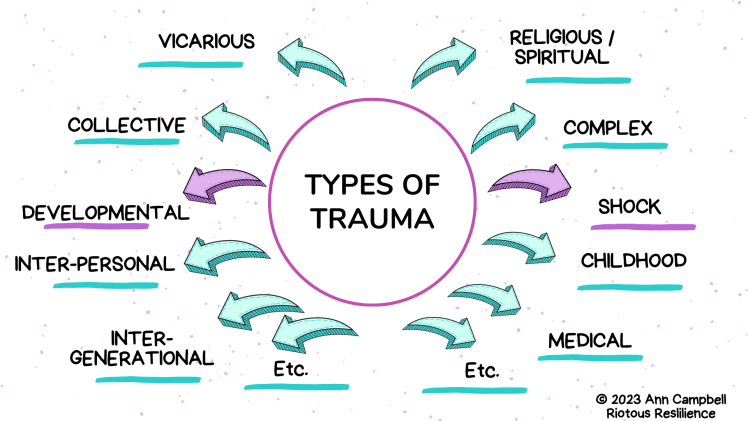
And just because someone else has experienced something different, doesn’t mean your experience doesn’t count.
In fact, one of the insidious effects of trauma is that it causes us to minimise our experiences and their effects on us. By nature, something that traumatises us overwhelms our capacity to cope. So, our brain protects us by convincing us we’re fine – “I can manage.” “It’s not so bad.” “This happens to everyone.” “I’m just overreacting.” Our smart brains use comparison to seal the argument – “Well, compared to what happened to my client, this is nothing!”
At the same time, the effects show up in our bodies, our emotions, our thoughts and our behaviours. We might be unable to sleep, anxious, grumpy, jumpy, judgemental, lack concentration, have aches and pains, be constantly tired and unmotivated, stressed, distressed, repeatedly sick, live with inflammation or autoimmune issues, struggle to eat, eat too much, drink or smoke or do drugs to take the edge off… the list goes on and on. Not everything we feel or struggle with is related to trauma, of course. But when it is, it helps to identify that so we can begin to deal with it and improve our lives.
I came to understand that trauma had affected my life by starting, not with a definition of trauma or an inventory of events in my life, but with understanding how I was feeling and figuring out why. A simple example of how this works happened when I was having a massage. While massaging my shoulders, the massage therapist slipped her fingers over my shoulder, close to my collarbone. I gave her half a heart attack by grabbing her wrist and wrenching it immediately away from me. It took me a few seconds to realise what I’d done and that I was still hanging onto her wrist, keeping her at arm’s length. (She’s a very wonderful, empathic massage therapist and has since forgiven me for the fright I gave her!). It was pretty simple to trace this automatic physical and emotional response back to the fact that I broke my collarbone when I was eight. My body had stored the memory. When she touched me, I instantaneously felt the crushing weight as if it was going to snap again and reacted in the way I couldn’t when I broke it 25 years before.
Most people will experience a traumatic event at some time in our lives. For those of us providing services to or working on behalf of trauma survivors, our jobs can make things worse. Professional expectations, organisational culture, workplaces that are insensitive to trauma, and exposure to our clients’ traumas add more stress.
Lawyers and law students are notoriously anxious, stressed, depressed and at risk of suicide. Charity or nonprofit workers can experience very significant levels of emotional and psychological distress. Human rights advocates report levels of PTSD, depression and burnout that are similar to those for first responders and combat veterans. On top of everything else, many of us have one or more identities that leave us open to discrimination or oppression: queer and trans folk, women, neurodivergent folks, people who grew up or live in poverty, ethnic or religious minorities, disabled people.
Not all of our physical or emotional reactions can be traced back as easily as my broken collarbone. But, with some curiosity and a lot of non-judgement, many can be. We can then do the work to stop them getting in our way and ramp up our resilience. Using a few well-targeted tools, I’m fine now with people touching my collarbone. It’s not my favourite thing but it doesn’t make me (or them!) jump out of my skin anymore. Whatever is keeping you stuck, the first step is understanding. Then the rest of the work comes and your riotous resilience begins to shine through.
Copyright © 2023 Ann Campbell. All rights reserved T&Cs, Privacy Policy
 Riotous Resilience